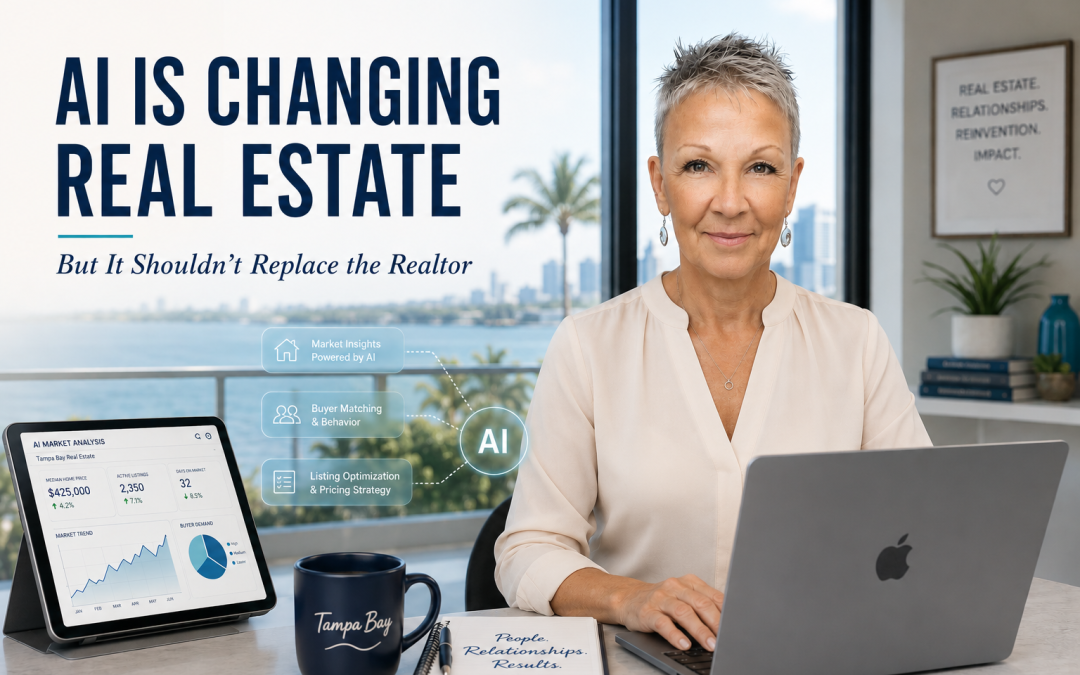
Artificial intelligence is quickly becoming part of the real estate business.
I use AI regularly in my own business, and I’m actively learning how to use it better. It can help me research, organize information, brainstorm marketing ideas, draft communications and handle some of the repetitive work that takes time away from my clients.
But there’s an important distinction I think both Realtors and consumers need to understand:
AI can be a powerful tool for your Realtor. It shouldn’t become your Realtor.
That conversation has become even more important as the National Association of REALTORS® has provided brokerages with an AI policy template designed to help establish guidelines for responsible AI use.
The guidance touches on issues including human oversight, accuracy, privacy, security, Fair Housing and accountability.
And those issues matter just as much to buyers and sellers as they do to real estate professionals.
AI Can Provide Information. Your Realtor Provides Context.
Imagine you’re considering two homes in the Tampa Bay area.
On paper, they’re remarkably similar. They’re the same size, in the same general area and perhaps even built around the same time. Yet one sold for considerably more than the other.
AI can analyze the numbers.
But numbers don’t always tell the whole story.
Was one property completely renovated? Was there a significant difference in location within the neighborhood? Did one back up to a busy road? Were there flood-zone considerations? Was there an unusual seller motivation? Did one property have issues that weren’t immediately obvious from the listing?
This is where experienced human judgment becomes incredibly important.
Real estate isn’t simply about retrieving information. It’s about understanding what that information means for a particular buyer or seller.
There Are Things AI Shouldn’t Decide for You
Real estate transactions involve enormous amounts of information, and increasingly sophisticated AI tools can help process it.
But there are also decisions that require judgment.
Should you offer $10,000 less or $30,000 less?
Is that inspection issue serious enough to reconsider the purchase?
Is a seller’s asking price unrealistic, or is there something about the property the comparable sales don’t capture?
Should you repair something before listing, or would you be better off pricing accordingly?
What happens when a transaction suddenly starts going sideways?
Those aren’t questions I want technology answering for my clients without human involvement.
AI can help gather information and identify things worth investigating.
The Realtor still needs to think.
Your Information Matters Too
There is another side of AI that consumers may not immediately consider: privacy.
Real estate professionals routinely handle financial information, contracts, personal circumstances and other sensitive client information.
As AI becomes more integrated into everyday business tools, Realtors and brokerages need to think carefully about what information is being entered into these systems and how it is being used.
The convenience of technology doesn’t eliminate our responsibility to protect our clients.
So Why Am I Excited About AI?
Because I don’t want to spend my time doing things technology can do efficiently.
I’d rather spend that time talking with my clients.
Researching a property more deeply (one of my favorite things to do!)
Calling another agent to get information that isn’t in the MLS.
Looking at comparable sales.
Developing a negotiating strategy.
Solving a problem.
Or simply answering the phone when a client is nervous about what happens next.
That’s where I believe AI has tremendous potential in real estate.
The goal shouldn’t be to remove the Realtor from the transaction. The goal should be to remove some of the busywork from the Realtor’s day.
That gives good agents more time to do the things technology can’t easily replicate.
Listen. Advise. Negotiate. Investigate. Advocate. Build relationships.
The Future of Real Estate Is Probably Both
I don’t believe the choice is between technology and personal service.
The best real estate experience will increasingly include both.
I want access to powerful technology, better data and AI tools that help me work faster and uncover information I might otherwise miss.
But when someone is buying a first home, selling a home they’ve lived in for 30 years, relocating their family, purchasing an investment property or trying to navigate an unexpected problem during a transaction, they deserve something technology alone can’t provide:
A knowledgeable human being sitting on their side of the table.
AI is going to change real estate.
In many ways, it already has.
My goal isn’t to compete with it. It’s to learn how to use it responsibly so I can spend more of my time doing what I became a Realtor to do in the first place:
Helping people make confident decisions about what comes next.